ChordFont
Jazz chord symbols, engraved properly — as a font.
npm install @chordlang/font
Jazz chord symbols, engraved properly — as a font.
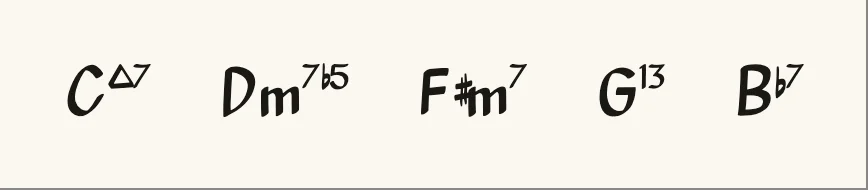
npm install @chordlang/fontChordFont is an OpenType font that turns plain text like Emaj7#11 or Am7b5
into publisher-quality engraved chord symbols. No rendering library, no canvas,
no SVG pipeline — the engraving logic lives inside the font itself, so anywhere
you can set a typeface, you can typeset Real Book-style chords.
Most chord-rendering projects ship a JavaScript library or an image generator,
which means every use case requires an integration. A font inverts that: every
text field in the world becomes a renderer. Out of the box it works in notation
software text blocks (Dorico, MuseScore, Finale), word processors, Figma
mockups, DAW markers, slide decks, web pages via a single @font-face rule, and
anything that exports to PDF — the engraving survives export because it is the
text. There’s no SDK to adopt and no runtime to version; distribution is just
installing a font, which is a workflow musicians and engravers already
understand.
That’s the wedge. Because the whole pipeline — grammar, normalizer, glyph
substitution rules — is ours, first-party tooling can sit on the same core: a
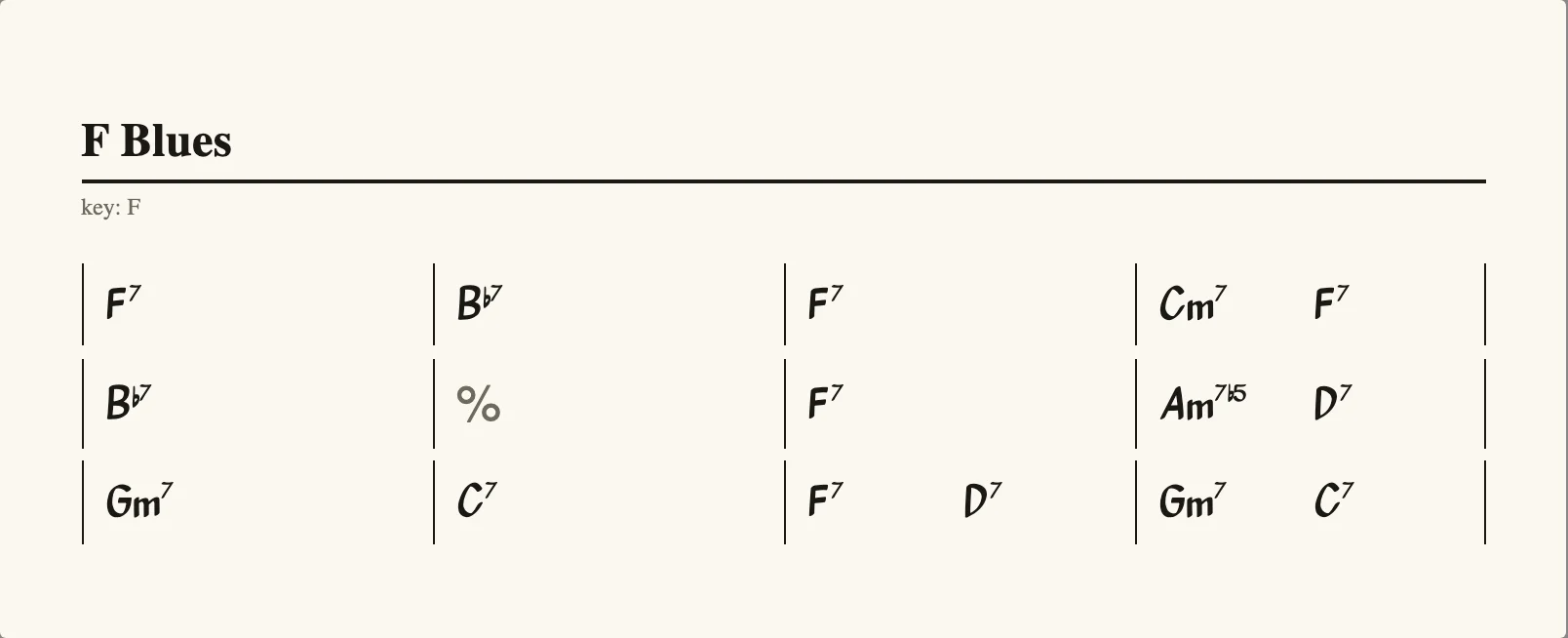
web playground, a lead-sheet editor (.cfmd charts), harmonic graphs
(.cfgv / Graphviz), a hosted rendering API, and a companion stafffont for
staff notation. The font gets ChordFont into existing workflows for free; the
tools are where the product surface grows. The monorepo ships as
chordlang.
The pipeline has a deliberate split between harmony and engraving.
Harmony lives in the normalizer. A PEG grammar parses chord syntax, and a
normalizer (wrapping tonal) resolves it into
a canonical factor set. This is where music-theory rules apply — for example,
altered fifths use replace-not-append merging, so E7b5 correctly replaces
the perfect fifth rather than stacking a ♭5 on top of it (verified across E7,
E9, and E13 with both ♭5 and ♯5).
Engraving lives in the font’s GSUB tables. Once text is normalized, there’s
no render-time tokenization — the font consumes the plain string and OpenType
glyph substitution does the rest. Ligature and contextual substitutions map ASCII
sequences to engraved forms: maj7 to the triangle, m7b5 to the
half-diminished ø, superscripted tension stacks, and so on.
The subtle part is accidental binding: a flat after a root letter (Bb) is
visually a different object than a flat inside an alteration (b9), and the
font resolves this contextually — flat.root / sharp.root glyph forms are
substituted only when the accidental follows a note letter A–G, with .alt
forms used everywhere else. That distinction — which accidental “belongs” to
what — is exactly what separates engraved output from
text-with-music-symbols-pasted-in.
Each concern has its own spec: the GSUB shape tests are the engraving spec, the normalizer test suite is the harmony spec, and a stress-test harness renders the full chord vocabulary as a regression fixture, so glyph-metric changes can’t silently break shapes elsewhere.
Glyphs derive from Petaluma (Steinberg’s handwritten SMuFL font) and are licensed under the SIL Open Font License. The font itself stays OFL — free forever — which is precisely what makes the strategy work: nothing stops the font from spreading, and the commercial surface is the tooling built on top of it.
@chordlang/* packages (parser, chord, render, font, graph, cli)stafffont for staff notation